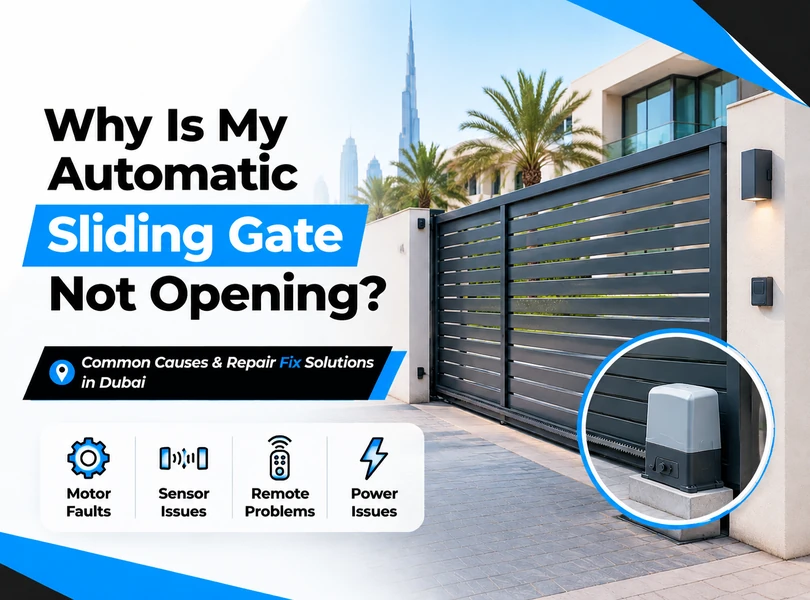
Common Causes and Repair Solutions in Dubai
An automatic sliding gate that refuses to open can disrupt daily access to your villa, residential community, commercial property or parking facility. The problem may be related to the gate motor, electrical supply, remote control, safety sensors, track alignment or mechanical components.
If your sliding gate is stuck, stops halfway or responds inconsistently, identifying the underlying fault is important before deciding on a repair.
In Dubai, outdoor gate systems can also be exposed to dust, sand, heat and other environmental conditions that may affect moving parts and electronic components over time.
This guide explains the most common reasons why an automatic sliding gate stops working, the warning signs to look for and when professional sliding gate repair may be necessary.
Why Is Your Automatic Sliding Gate Not Opening?
An automatic sliding gate may stop working due to electrical, mechanical or control-system problems. Here are seven common causes.
Power Supply Issues
Electrical interruptions or control-board faults can stop gate operation.
Faulty Remote Control
Weak batteries, receiver faults or signal interference may prevent response.
Safety Sensor Problems
Dirty or misaligned photocells may interrupt normal gate movement.
Track Obstructions
Dust, stones or debris can create resistance along the gate track.
Worn Rollers
Damaged rollers or guide components can cause uneven movement.
Gate Motor Failure
A faulty motor or drive mechanism can prevent the gate from opening.
Control & Limit Faults
Incorrect position feedback or limit-control faults can interrupt movement.
1. Power Supply or Electrical Control Problems
One common reason for an automatic sliding gate not working is an interruption in its electrical supply or a fault within its control system.
Automatic gates depend on electrical components to receive commands and operate the motor. If the power supply or control unit develops a problem, the gate may stop responding.
Common warning signs
- The gate does not respond to the remote.
- The motor does not appear to activate.
- The control unit shows an unusual indicator or error.
- The gate operates inconsistently.
What is the solution?
A professional inspection can help determine whether the issue relates to the power supply, control board, wiring or another component.
Avoid opening electrical enclosures or attempting electrical repairs yourself. These components should be inspected by a qualified technician.
2. Faulty Sliding Gate Remote Control
Sometimes the problem is not with the gate itself but with its remote control or receiver system.
Automatic sliding gates generally use a transmitter to communicate with the gate operator. If the transmitter is faulty or the receiver cannot recognise its signal, the gate may not respond.
Possible causes
- Weak remote-control batteries.
- A damaged transmitter.
- Signal interference.
- Receiver malfunction.
- Remote and gate operator compatibility issues.
How can you identify the issue?
Observe whether the gate responds to another authorised control method, if one is available.
If other controls operate the gate but the remote does not, the transmitter or receiver may require professional inspection.
3. Dirty or Misaligned Safety Photocells
Safety photocells are important components of many automatic sliding gate systems.
They use an infrared beam to detect an obstruction within a designated area. Depending on the system configuration, an interrupted or faulty beam may prevent the gate from closing or change its movement.
Signs of a photocell problem
- The gate opens but refuses to close.
- The gate reverses unexpectedly.
- The system displays a sensor-related fault.
- Gate operation becomes inconsistent.
Recommended solution
A technician should inspect the photocells, alignment, connections and safety-system configuration.
Some manufacturer manuals include basic external lens-cleaning guidance for users. Always follow the specific manufacturer’s instructions and do not interfere with the electrical connections or safety settings.
Important: Never bypass safety photocells to force a gate to operate. These devices are part of the gate’s protection system.
4. Obstructions or Problems With the Sliding Gate Track
An automatic sliding gate moves along a designated track or guided movement system.
If debris, stones, dirt or other obstructions interfere with its movement, the gate may become difficult to operate.
This is particularly relevant for outdoor installations where dust and debris can accumulate over time.
Common symptoms
- The gate stops at a particular position.
- Unusual friction or noise occurs during operation.
- The gate moves unevenly.
- The motor appears to operate but the gate does not travel normally.
Professional repair approach
A technician can inspect:
- Sliding gate track condition
- Gate alignment.
- Guide rollers.
- Supporting wheels.
- Mechanical obstructions.
- Drive-system condition.
Do not force a stuck gate or attempt to move a malfunctioning powered gate manually without following its specific manufacturer-approved safety procedure.
5. Worn-Out Rollers or Guide Components
Sliding gates depend on properly functioning rollers and guide components to maintain smooth movement.
With repeated operation, components can experience wear and deterioration.
When rollers become damaged or the gate develops alignment problems, the system may experience increased resistance.
Warning signs
- Grinding or unusual operating noises.
- Uneven gate movement.
- Visible alignment problems.
- Repeated stopping during operation.
What should be checked?
A professional inspection should assess the condition of the rollers, guide assemblies, track and supporting structure.
Replacing a damaged component may restore smooth operation, but the technician should first identify the underlying cause of the wear.
6. Sliding Gate Motor or Drive Mechanism Failure
The sliding gate motor provides the power needed to move the gate.
If the motor or its associated drive mechanism develops a fault, the gate may stop working completely or operate inconsistently.
A motor-related problem can sometimes appear similar to a track or alignment issue.
Common symptoms
- The motor makes an unusual noise.
- The gate moves slowly or stops unexpectedly.
- The motor responds but the gate does not move correctly.
- The gate experiences repeated operational failures.
Sliding gate motor repair or replacement?
The decision depends on:
- The actual cause of the malfunction.
- Motor condition and compatibility.
- Availability of replacement components.
- Gate weight and operating requirements.
- Repair history and overall system condition.
A technician should inspect the complete gate system before recommending sliding gate motor repair or replacement.
7. Limit Switch or Control-System Problems
Automatic sliding gates use position-control systems to determine when the gate should stop during opening and closing.
If position feedback, limit-control components or related settings develop a fault, the gate may stop too early, travel incorrectly or fail to complete its movement.
Common indicators
- The gate stops before reaching its normal position.
- The gate does not complete its opening cycle.
- The gate behaves differently during opening and closing.
- Repeated movement problems occur despite an apparently functioning motor.
These issues require model-specific technical diagnosis. Avoid changing force limits, travel limits or controller settings without qualified assistance.
Common Automatic Sliding Gate Problems and Their Possible Causes
| Gate Problem | Possible Cause |
|---|---|
| Gate Does Not Open | Power, remote, control or motor fault |
| Gate Opens but Does Not Close | Photocell or safety-device issue |
| Gate Stops Halfway | Mechanical resistance or position-control fault |
| Gate Moves Slowly | Roller, track or drive-system problem |
| Gate Makes Unusual Noises | Worn or damaged mechanical components |
| Gate Operates Inconsistently | Control, sensor or electrical issue |
When Should You Contact a Sliding Gate Repair Technician?
You should arrange a professional inspection if:
- Your gate repeatedly stops during operation.
- The gate becomes uneven or visibly misaligned.
- You notice unusual mechanical noises.
- The gate does not respond consistently.
- Safety sensors appear to malfunction.
- The gate or its supporting components appear damaged.
If a gate behaves unpredictably or appears unsafe, stop using it and keep people away from its movement area until it has been inspected.
A professional assessment can identify whether the problem requires motor servicing, component replacement, sensor inspection or a more comprehensive repair.
Why Regular Sliding Gate Maintenance Matters in Dubai
Regular maintenance helps identify developing problems before they cause unexpected interruptions.
Outdoor sliding gate systems may experience environmental exposure, frequent operation and gradual mechanical wear.
A suitable maintenance programme should be based on the manufacturer’s instructions, gate usage and installation conditions.
Important maintenance areas include:
- Gate track and guide system: Check for deterioration and obstruction.
- Rollers and supporting components: Inspect for wear.
- Gate motor: Check its operating condition.
- Safety photocells: Verify that protective devices function correctly.
- Control system: Review operating performance and fault indicators.
- Structural components: Inspect alignment, fixings and visible deterioration.
For commercial properties and residential communities, maintaining service records can also help facility managers monitor recurring issues.
Why Choose Quick Fix Door for Sliding Gate Support in Dubai?
Choosing the right service provider is important when an automatic gate develops an operational fault.
Quick Fix Door lists sliding gate and barrier gate support among its access-system solutions in Dubai.
The appropriate service depends on the type of gate, its operating mechanism and the problem identified during inspection.
Before arranging a repair, property owners should understand:
- What caused the gate malfunction?
- Does the issue involve the motor or mechanical components?
- Are replacement parts required?
- Will the safety devices be checked?
- What is included in the proposed quotation?
To discuss your requirements, visit Quick Fix Door’s gate and barrier systems or contact the team.
Frequently Asked Questions
1. Why is my automatic sliding gate not opening?
An automatic sliding gate may not open because of a power interruption, remote-control issue, faulty motor, control-board problem, track obstruction or mechanical fault. A professional inspection is required to identify the exact cause.
2. Why does my sliding gate stop halfway?
A sliding gate may stop halfway because of mechanical resistance, damaged rollers, track problems, position-control faults or an issue with the motor. The complete operating system should be inspected.
3. Why does my sliding gate open but not close?
Possible causes include obstructed or misaligned photocells, safety-device activation or a control-system fault. Never bypass the safety system to make the gate close.
4. How do I know if my sliding gate motor is faulty?
Unusual motor noise, inconsistent movement, repeated stopping or a motor that operates without normal gate movement may indicate a problem. However, similar symptoms can result from mechanical or control-system faults.
5. How often should an automatic sliding gate be serviced?
Service frequency depends on the manufacturer’s recommendations, operating cycles, environmental exposure and installation conditions. Follow the specific gate operator’s maintenance manual and arrange periodic professional inspections.
6. Can a sliding gate motor be repaired?
Yes, some motor-related faults may be repairable. However, replacement may be more appropriate when the motor is significantly damaged, incompatible with the system or no longer economical to repair.
7. Who provides sliding gate repair in Dubai?
Quick Fix Door lists sliding gate and barrier gate solutions on its website. Property owners can contact the team to discuss their gate requirements and arrange an appropriate service assessment.
Final Thoughts
An automatic sliding gate that refuses to open or close can have several possible causes, ranging from remote-control problems to motor, sensor and mechanical faults.
Understanding these issues helps property owners make informed decisions and avoid unnecessary repairs.
The most important step is to identify the actual cause before selecting a solution.
For sliding gate repair and access-system support in Dubai, contact Quick Fix Door to discuss your requirements.
External References & Technical Resources
For additional guidance on automatic gate safety, operation and maintenance, consult these manufacturer and industry resources:
- Health and Safety Executive (HSE) – Powered Gate Safety
- CAME – Sliding Gate Automation Installation Manual
- Centurion Systems – D3 Smart Gate Operator Manual